

Admittedly, this may be too in-the-weeds for some of you, so I offer my apologies in advance for the journey into newsletter-subscription nerd-dom.
About 20 months ago, The Amalgamation Newsletter arrived at Ghost. Over the years, this little blog of mine has had a variety of homes and names. From Typepad to freelance sites, I have been in the blogging game a long time. Aside from that one time when I lost years of posts during one blog transfer, I have made good choices when it comes to platforms and services.
I'm pleased I made the move from Substack to Ghost.
For those wondering, "What the heck is Bruce talking about?" you are probably not alone. Back in the olden days, when folks were blogging, if you wanted to try and make a living or part of a living through your newsletter or blog, there was no easy way to build up and manage subscribers. Today there are many ways to do this, with Substack probably the most popular. Plenty of Substack alternatives exist, so after deciding that it was time to move on, I landed on Ghost.
Below are some thoughts on the move, followed by a review of the Ghost platform.
Reflections on the Move
Last year, I started to feel that Substack wasn't the place for me. Anil Dash, whom I greatly respect, pushed on the idea of who owns what in Don't Call it a Substack. In a January 2025 post, The fight for free speech in 2025 and beyond Substack co-founder, Chris Best, shared his thoughts on speech and what moderation will look like on Substack, including praise for Elon Musk and Meta for their approaches to free speech.
Elon Musk has been a vocal supporter of free speech. It’s no secret that we haven’t always seen eye to eye, but he deserves a lot of credit for advancing freedom of speech on X, before it was popular and in the face of fierce criticism and opposition. But Musk’s record is not perfect—he has been credibly accused of censoring his political opponents in addition to his commercial ones. Mark Zuckerberg recently announced favorable changes in policy for Meta that should result in freer expression on its platforms. His stated reasons were a change in public sentiment and a new administration, reflecting a real change in the culture. Those who welcome the press freedom changes at Meta owe a debt to those who took a principled stand when the wind was blowing the other way.
You can read my original post for others' opinions, but the final straw for me was when Substack partnered with and profited from Bari Weiss and her Substack, The Free Press, which, according to The Press Gazette, has netted Substack a pretty penny,
The Free Press has more than 170,000 paying subscribers (mostly paying $10 per month), which could mean revenue of about $18.4m after Substack has taken its 10% share. Paramount said revenue was up 82% in the past year. It also has around 1.3 million free newsletter subscribers.
The interwebs can give you all you need to know about the journalism of Bari Weiss, The Free Press, and now CBS, but here is a good piece by The Guardian about her Trumpian, pro-Israel positions, Disgruntled NYT journalist to ‘anti-woke’ power grab: how far can Bari Weiss go?
After leaving the New York Times, she turned her Substack into an unshakable pro-Israel voice. Now as Paramount eyes acquisition of her company, Weiss is poised to become Trump’s ally among media elites
As I have shared before, none of us is pure in our choices, and I am not throwing shade at those who stayed or have since joined. I simply chose to move away from the Substack ecosystem, and I am still glad I did.
I still have a Substack account where I occasionally repost some of my content, and I follow back anyone who follows me there. I have unsubscribed from most of the Substack newsletters that I followed and rarely read, and I will soon start posting a quarterly recap of posts from my current newsletter over on Substack.
My Thoughts on Ghost as a Newsletter Platform
Below are some reflections on my time using Ghost.
Vibes
I start here because, from coffee houses to my workspaces, vibes are important to me. When I switched over and interacted with Ghost Support, it became clear that Ghost was the one for me. Ghost gives much more room for creativity and feels personal. Where Substack gives uniform condo or housing development, Ghost gives beadazzled tiny homes. Hand me the beadazzler!
Cost of Services
Ideological differences aside, the most compelling reason I chose Ghost was that it is less expensive. Ghost charges based on subscriber count, while Substack takes a percentage of the monthly total.
I currently pay $460/annually for nearly 2,500 subscribers on Ghost.
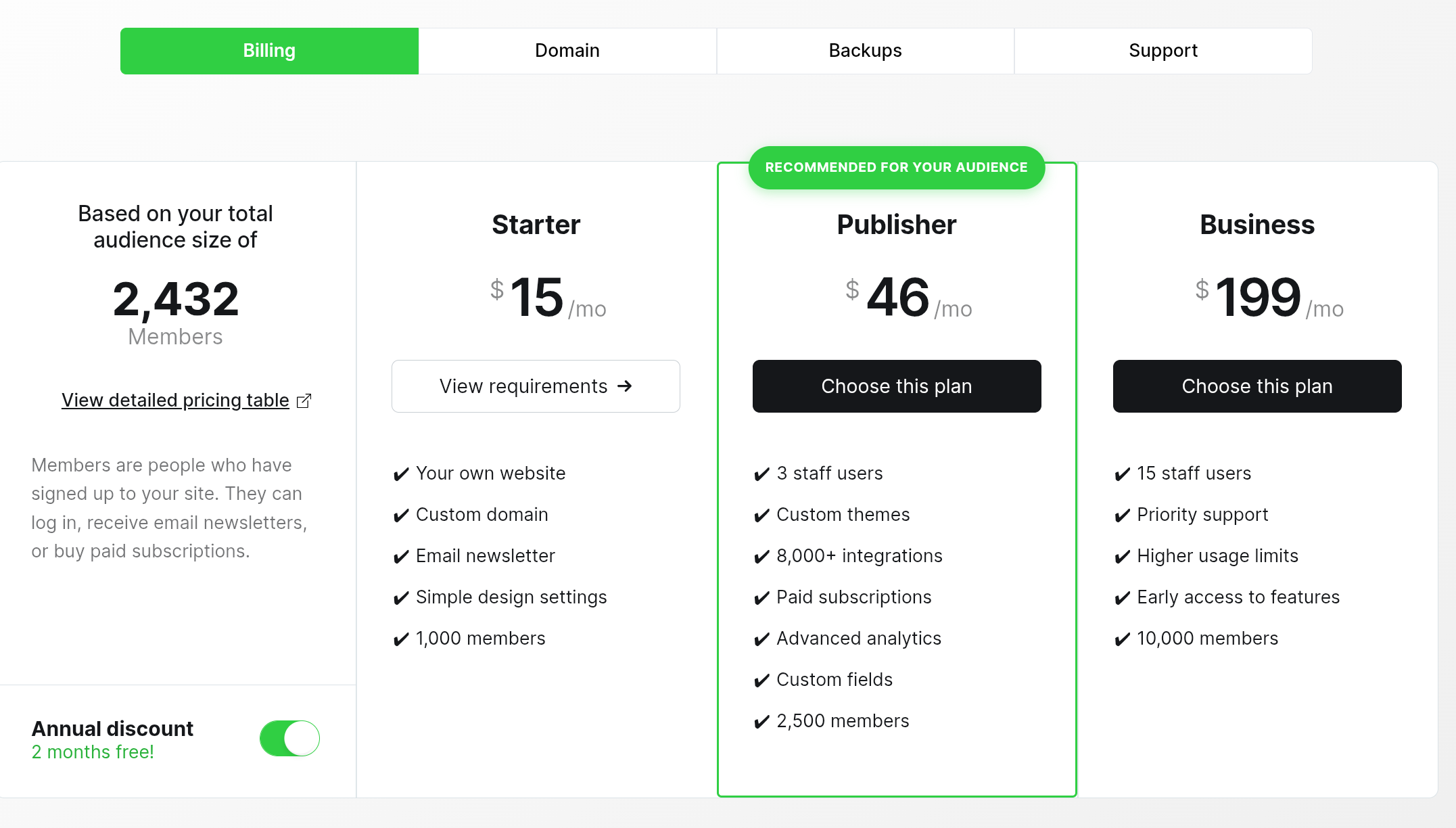
With my 2,432 subscribers, I earn $712/month or $8,544/annually through my paid subscriptions (Thank you for the support). With Substack's 10% cut, I'd pay them around $850 annually, saving me $390/annually. Now think about how much Substack is collecting from its big newsletters 🤯. And yes, that means that 10% of everyone's subscription money goes to Substack.
Because Ghost charges based on subscriber numbers and not total dollars, the gap will only increase as my paid subscriber numbers grow. Right now, I am just below Ghost's next cost tier at 2,500 subscribers, so let's manifest doubling that number at the current paid subscriber rate. At just under 5,000 subscribers, my annual Ghost fees would be $63/month or $630/annually. If my monthly subscription amount also doubled to $1,424/month or $17,608/annually, Substack would take $1,760. If this increase in paid subscribers happened, Ghost would save me $1,130/annually.
The cost question was, and still is, a no-brainer for me.
Design and Creation
The second most compelling reason I moved was because of design freedom. You can only do so much with Substack to make it look unique. For the most part, every newsletter looks the same, not so on Ghost. Like WordPress, you can choose free or paid themes that bring a bit more life to the newsletter's look. I did my best to add some individuality to my design, but Substack offers very little customization beyond color themes and font selection. In the end, people like what they like, but to me Substack gives uniform condo housing development, while Ghost gives beadazzled tiny homes. Hand me the beadazzler.
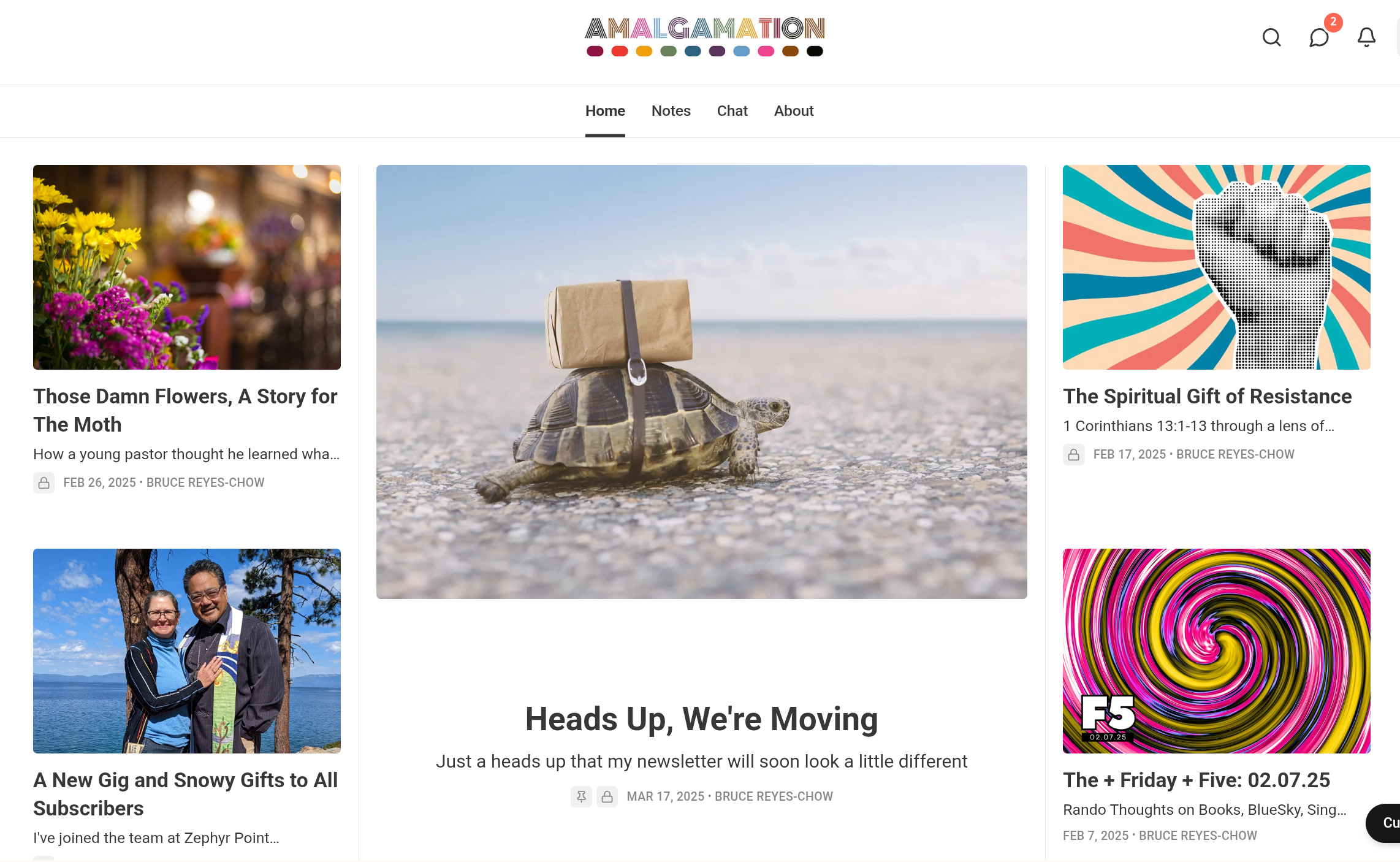
My current design...

At the end of the day, newsletters are about content, but vibes don't hurt.
Migration and Support
Another reason I chose Ghost is that it also uses Stripe as its payment platform. This means I didn't have to transfer names, subscription tiers, or payment sources. The migration process is also pretty straightforward. We ran into a few issues, but we quickly figured them out because Ghost support is amazing! The Ghost help section is pretty good, but the response time and helpfulness are super solid. No AI agents here, my friends.
Domain Name
One of the things that I wanted to do in this move was to consolidate as much of my content in one place. That meant I wanted a dedicated domain name. On Substack, you pay a one-time fee of $50, and the domain name acts more like a redirect than a true domain name. Because of this, my Substack address would show up every once in a while. The domain setup on Ghost is free and not difficult. This feature isn't a deal-breaker, but Ghost has the edge.
Creation and Content
I have found the difference in what you can do for content creation is negligible between the two. If you know how to post on Substack, you know how to post on Ghost, so this is a wash.
Image Creation
One of the first things I noticed and missed when I started posting from my new location was that Ghost didn't auto-create images for sharing as Substack does.

As of today, I no longer miss this feature. While I do miss the efficiency of those handy graphics, I can do the same thing in Canva without much effort. I know this isn't true for everyone, but this way, my online footprint can communicate the same vibes as my main site.
The Substack Referral Ecosystem and Community Interaction
While my readership and paid subscriber numbers have increased since I moved, I have no doubt that those numbers would be much higher if I were still in the Substack ecosystem. The writer-to-writer referral system is, by far, the feature I miss the most. On Substack, I got hundreds of subscriptions through those referrals. Substack not only pushes referrals when you first subscribe, but also emails folks to let them know which newsletters your Substack connections recommend. While most folks probably don't read all the newsletters they are subscribed to, the pool of potential paid subscribers would be much higher if I were still on Substack.
The other Substack ecosystem features that I miss a little bit are the chat and notes features. I'm not sure how effective they are at growing subscriber numbers or increasing open rates, but having these two sharing features open creates two more possible touchpoints with subscribers that Ghost doesn't have.
The Outpost Add-on
One feature I wanted to add was a way for subscribers to purchase a Gift Subscription without the recipient having to enter their credit card information. After a little research, I found the Outpost Publishers Cooperative and their gift program is awesome. Outpost is a service that turbocharges Ghost newsletters. Outpost not only offers ways to improve content, but also has an excellent subscriber retention flow. I haven't had a chance to explore some features, but I look forward to discovering more ways to improve the experience.
If you want more, here is Ghost's side-by-side Substack comparison. If you want to make the leap, here is my Ghost-Pro referral code. And if you want to give someone a gift subscription for the holidays, I would not hate that.
Well, that's all I have. Thanks to everyone who's hung out with me over the years or the past few weeks. You are deeply appreciated.
Peace,



Member comments